
Morton's neuroma is the compression of a nerve passing between the toes, or thickening of the tissue around one of the nerves to the toes. A neuroma is a thickening of nerve tissue that can develop in various parts of the body. Morton's neuroma, the most common type, is a painful condition affecting the underside of the foot, most often the area between the third and fourth toes. It feels as if you are stepping on a pebble in your shoe or standing on a fold in your sock. It causes persistent pain in the ball of the foot and can also feel like walking on a marble. Although it is called a benign nerve tumour, Morton's neuroma cannot really be classed as a tumour. It is usually seen between the 3rd and 4th toes.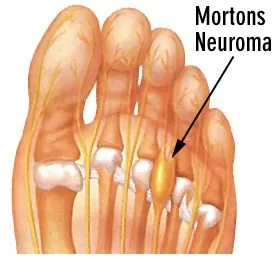
What are the symptoms of Morton's neuroma?
Contrary to popular belief, there is no visible lump on the sole of the foot. Instead, it can cause sharp, burning pain in the sole. Numbness, burning or stinging may be felt in the toes.
Causes of Morton's neuroma
Morton's neuroma is 10 times more common in women than in men and usually develops as a result of injury or excessive pressure. Individual anatomy and certain habits (high-heeled shoes, sports such as running that repeatedly load the sole of the foot) are the main causes. Foot deformities (bunions, curled toes, high-arched feet or flat feet) are also risk factors.
How is Morton's neuroma diagnosed?
Early diagnosis greatly reduces the need for more invasive treatment and postpones surgery. The diagnosis is usually made by physical examination. In doubtful cases the lesion can be seen on MRI with contrast. X-rays help to rule out other conditions.
How is Morton's neuroma treated?
First, the patient is advised to wear comfortable shoes, the aim being to reduce pressure on the nerve. Besides changing shoes, anti-inflammatory medication and metatarsal pads are used. Non-surgical treatment reduces complaints in only 15–20% of patients.
If there is no improvement despite all this, surgery is considered. Through a 2–3 cm incision over the transverse ligament between the 3rd and 4th metatarsals, the ligament is cut to free the nerve, or the thickened nerve segment is removed. Rest for 15 days is recommended after surgery, and comfortable shoes should be worn for 6–8 weeks. Full recovery takes about 8 weeks on average. With surgical removal of the lesion, complaints can disappear completely in up to 85–90% of cases.
The information on this page is for general information only and does not replace an examination and diagnosis.