
Kyphosis (hunchback), a posture disorder, is an increase in the normal forward curve of the upper back. Viewed from the side, the head of a person with kyphosis is further forward relative to the body, the back shows a hump, and the hollows of the lower back and neck are correspondingly increased.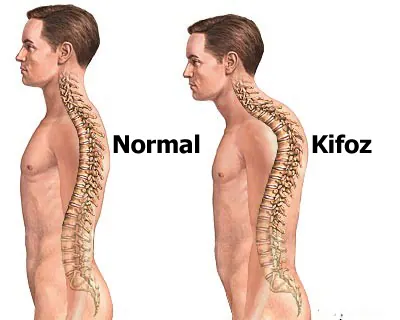 A curve of 20 to 55 degrees in the upper back is considered normal, but larger curves must be treated. Kyphosis in infancy can cause lung and heart disease, while in later life it can reduce lung capacity and cause breathing difficulty.
What causes kyphosis?
The main causes are:
- Congenital kyphosis: a segmentation or formation defect of the vertebrae, which may be accompanied by organ abnormalities.
- Idiopathic kyphosis (no known cause): the most common cause in adolescence is Scheuermann's kyphosis. It is structural and does not improve by correcting posture; there is a sharp curve in the upper back.
- Poor posture (postural kyphosis)
- Osteoporosis
- Spinal fractures
- Infections and tuberculosis of the spine
- Malnutrition and vitamin deficiency
What are the symptoms of kyphosis?
Kyphosis mainly causes low back, back, shoulder and chest pain, and may also cause headache, restricted shoulder movement, pain spreading to the arms and fingers, and pain, numbness and tingling in the lower back, hips and legs.
Kyphosis does not occur in isolation: it can lead to a flat back or increased lumbar lordosis, gait disturbances and, more importantly, breathing problems (difficulty breathing, rapid breathing) and fatigue.
How is kyphosis treated?
First the cause must be determined. The patient's and family's history of pregnancy, birth and early life is taken, along with when the kyphosis started and how it progressed. The patient is examined for other accompanying findings or diseases. The cause is established with X-rays and CT or MRI, and treatment is planned according to the cause.
In congenital kyphosis, surgery may be recommended after the age of one; other treatments do not help.
In idiopathic kyphosis, treatment depends on the degree measured on X-ray: exercise and rehabilitation for 50–55 degrees, additionally a brace for 55–70 degrees, and surgery for 70 degrees or more.
Postural kyphosis is not structural but due to a poor posture habit; the patient can correct it at will. The patient is therefore taught correct posture and sitting, and posture braces and exercise therapy are used.
The information on this page is for general information only and does not replace an examination and diagnosis.