
Clunking or clicking noises from our joints – especially from the hip – can alarm many people. A jumping or catching sensation with a noise on the side of the hip when walking, running, getting up from a chair or swimming, i.e. during rotation of the leg, is called "snapping hip syndrome", "clunking hip" or "noisy hip syndrome".
This sensation is usually painless and harmless but can sometimes be bothersome. Because it can involve pain and muscle weakness in young athletes and dancers, recognising the signs of snapping hip early is important for performance. Sometimes patients see a doctor thinking that the noises mean their hip is dislocating.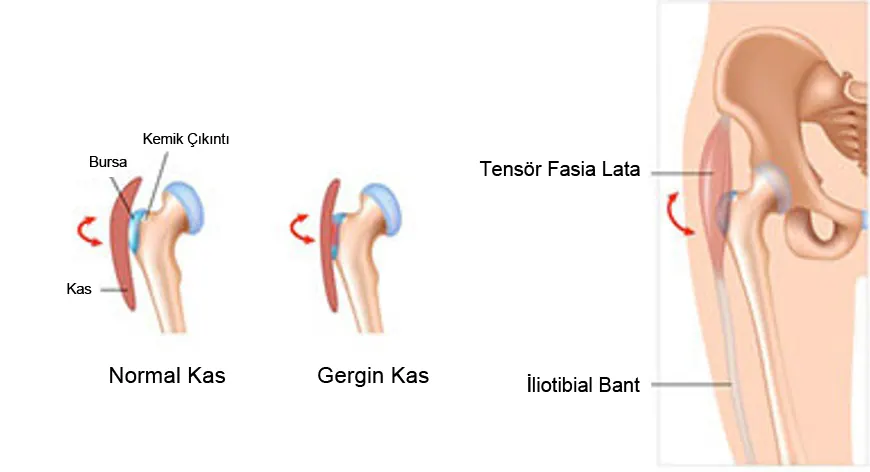
Why does the hip make noises?
When the hip is straight and upright, the iliotibial band lies behind the greater trochanter. When the hip bends, the band slides forward and jumps over it with friction. Over time this can lead to hip inflammation and trochanteric bursitis. It is caused by tight hip flexor muscles and a tense ligament controlling the hip (the iliotibial band) jumping over the prominence of the thigh bone. A jump or click felt on the outer side of the hip may be due to the iliotibial band moving over the bone, while a click at the front (pelvic area) may be due to the iliopsoas tendon that bends the hip. This problem is more common in people who overuse their hip flexors, such as dancers and athletes. The clunking or jumping usually occurs during bending and straightening of the hip. In runners, a noisy hip may indicate weakness of the muscles that rotate the hip inwards.
How is snapping hip diagnosed?
Many patients with snapping hip do not see a doctor unless it causes pain. However, if the noise is accompanied by pain or began after an injury or surgery, it may indicate a more serious problem. X-rays and MRI may be requested to rule out other hip causes. Loose bodies, partial dislocation of the hip (subluxation) and bursitis can make similar noises.
How is snapping hip treated?
Stretching exercises come first. The programme must include stretching of the quadriceps, iliotibial band, hamstrings and piriformis. Exercises involving extension of the hip and knee are useful. Weak hip muscles are strengthened. Painkillers from the non-steroidal anti-inflammatory group are helpful.
When physiotherapy does not help, operations to release the tendon, repair labral damage or remove loose bodies from the joint are performed.
The information on this page is for general information only and does not replace an examination and diagnosis.