
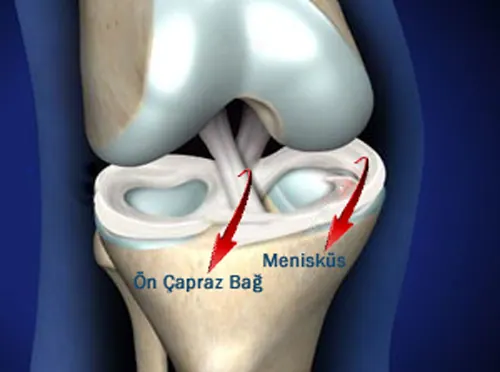
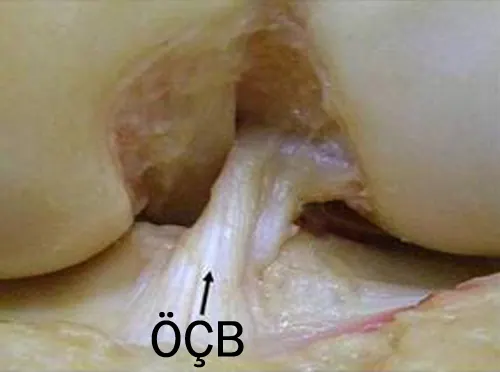
Where is the anterior cruciate ligament (ACL)? What does it do?
Inside the knee joint, between the thigh bone (femur) and the shin bone (tibia), behind the kneecap, there are two cruciate ligaments: the front one is called the anterior cruciate ligament and the back one the posterior cruciate ligament. The ACL connects the two bones and prevents the knee from sliding forward and rotating. It is a strong ligament that stabilises the knee, with an average diameter of 11 mm and a length of 38 mm.
How is the ACL injured?
The ACL usually tears during sport. The most common mechanism is a sudden twisting of the body over a planted foot in high-tempo sports such as basketball, football, volleyball and handball. Rarely, a tear can also result from high-energy injuries such as a direct blow, traffic accidents or falls from a height. These injuries may be accompanied by other ligament injuries, cartilage damage and meniscus tears.
In adults the injury is a partial or complete tear in the middle part of the ligament, whereas in children the ligament pulls off a piece of bone where it attaches to the shin bone.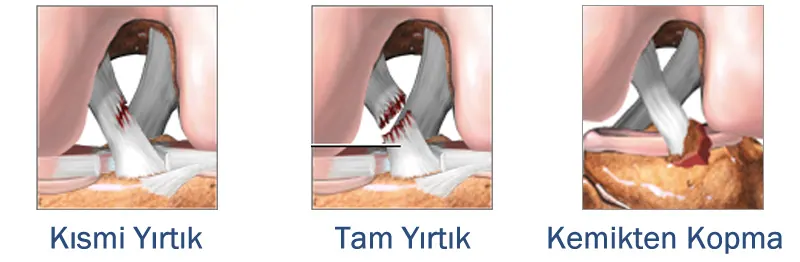
What does an ACL tear feel like? What should be done first?
During an ACL injury there may be a sudden tearing sensation and a popping sound in the knee. The athlete has to stop playing. Most people notice this sound clearly, and the knee swells within a few hours. The swelling is caused by bleeding into the knee from the torn ligament.
As first aid, the knee should not be strained but rested, ice and a bandage should be applied, and a doctor should be seen as soon as possible.
What symptoms does a patient with a torn ACL have?
Once the early period has passed, the swelling has gone down and knee movement has returned, a patient with a torn ACL complains of a feeling of insecurity and the knee "giving way" during sudden jumping, stopping and turning, and so cannot run or play sport. In daily life, patients say they cannot control their knee when getting off a bus, hopping on one leg and especially when going down stairs, and that the knee feels unstable.
One important point to remember: in ACL injuries the ligament may be strained or partly torn. In patients without a complete tear the symptoms may be milder. If this is overlooked, a complete tear develops more easily with a second injury.
How are ACL injuries diagnosed?
In a patient whose knee twisted during sport, with a popping sound and swelling, an ACL tear is the first diagnosis that comes to mind. Knees with an accompanying meniscus tear may also lock. On examination, a feeling of looseness in the knee and the absence of the ligament allow the diagnosis in 90% of cases. X-rays are taken to rule out bony injuries. An MRI may be requested to look for accompanying cartilage, meniscus and ligament injuries. However, because the knee is swollen in the first days after injury and the MRI can be misleading, a repeat MRI may be requested after the swelling has settled in patients where the diagnosis is uncertain.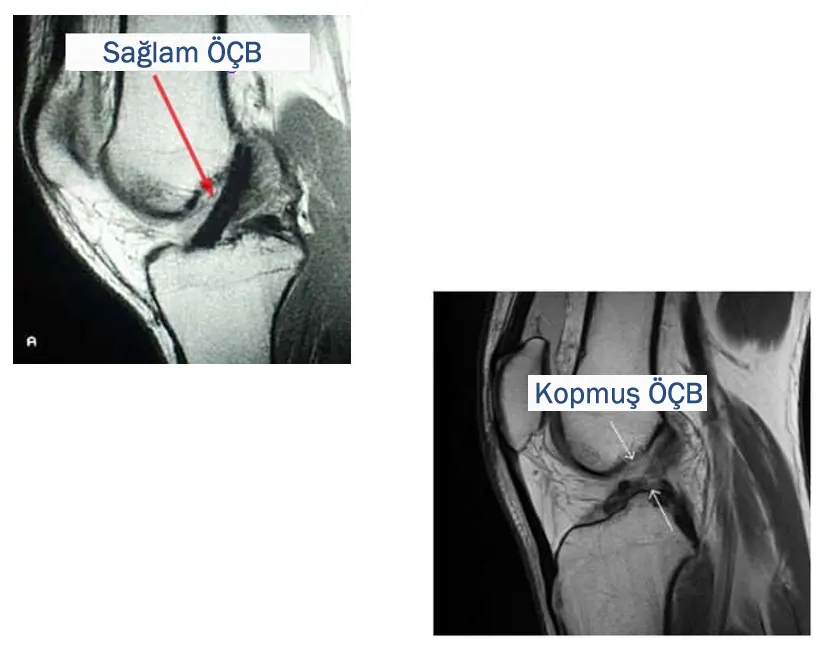
How is an ACL tear treated? Is non-surgical treatment possible?
If there are complaints of instability – the knee slipping or giving way – ACL surgery is needed. In young patients with such complaints especially, ACL surgery is essential. Scientific studies have shown that in patients whose ACL tear was not treated, X-rays taken after 10 years showed signs of osteoarthritis in 53%. If an ACL injury is repaired in time and properly, eliminating knee instability protects against meniscus and cartilage injuries that would otherwise occur. Therefore, contrary to popular belief, surgical treatment is the best option for functional results.
The ACL, which connects the two bones of the knee joint, is overstretched during the injury and tears with frayed ends. In addition, the ACL, overstretched by the movement of the unstable knee, does not heal on its own. For these reasons the treatment of a torn ACL is surgical. If an ACL injury is accompanied by pain and locking, an accompanying meniscus tear should be suspected. Only in children does the ACL tear away from its bony attachment together with a piece of bone, and it must be fixed back in the early period (first 3 weeks) with a special technique.
Today ACL operations are performed arthroscopically, i.e. with a closed method. The original ligament is replaced with tendons taken from other parts of the body (such as the hamstring or patellar tendon). Ligaments taken from a donor (cadaver) can also be used.
In patients over 50 who do not play sport actively and whose knee is not loose, or who have signs of osteoarthritis in the knee, non-surgical treatment can be preferred by keeping the muscles around the knee strong with exercise.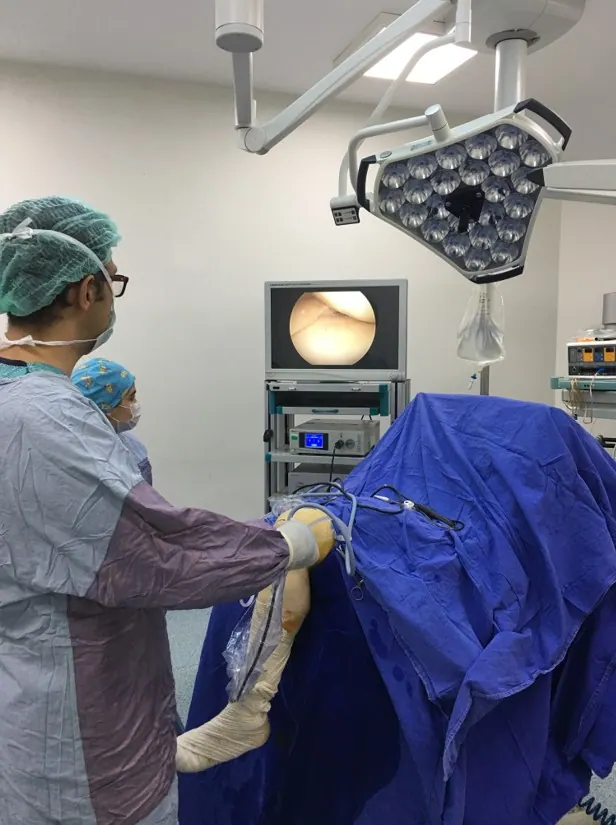
How is ACL surgery performed?
1. First, arthroscopy is performed to assess the structures inside the knee. If there is a meniscus tear, meniscectomy or meniscus repair is done. Cartilage damage is treated.
2. The remnants of the torn ACL are cleaned and the points where the new ligament will be placed are marked
3. The tendons that will replace the ACL are harvested and prepared
4. Tunnels are drilled in the knee where the ligament will be placed
5. The prepared ligament is placed in the tunnels using various methods
6. With the right tension, the ligament is fixed in the tunnel with absorbable screws. These screws that hold the ligament in place usually do not need to be removed.
How long does ACL surgery take?
Depending on the repair technique used and the variety of injured tissues that need repair, the operation lasts between 40 and 120 minutes.
Should ACL reconstruction be single-bundle or double-bundle?
Although the ACL looks like a single bundle, in recent years it has been shown to have two bundles, front and back. Although a double-bundle repair method was developed with this in mind, because no clear difference was seen in patients, many surgeons today use the single-bundle repair technique.
When will I be on my feet after ACL surgery?
The hospital stay after surgery is 2 days. Knee movements start on the same day. After surgery, weight-bearing with crutches starts as far as pain allows. The knee should be protected from overloading by using crutches for about 3 weeks and a long hinged knee brace for 6 weeks. Rehabilitation with a physiotherapist is of great benefit. With the post-operative exercise programme, almost full knee movement is regained within three weeks.
When can I drive after ACL surgery?
After surgery on the left knee, patients can drive an automatic car when they feel comfortable; after surgery on the right knee they can drive after 6 weeks.
When can I return to work after ACL surgery?
People with desk jobs can return to work in 3–4 weeks. Those doing physical work can return between 6 and 9 weeks.
When can I start sport after ACL surgery?
Recovery after ACL surgery varies from person to person. The reasons include the patient's muscle strength, age, the type and placement of the graft, the strength of the fixation, the surgical technique and other accompanying injuries. Patients usually do closed kinetic chain exercises for the first 6 weeks; after 6 weeks open kinetic chain activities such as cycling and swimming are started. After the 3rd month, patients can jog in a straight line. Generally, sports training becomes possible after 6 months, when the ligament has gained enough strength. Full maturation and strengthening of the graft takes a year. For this reason, starting contact sports after 9–12 months is recommended.
What is the success rate of ACL surgery?
Worldwide and in our country, the success rate is around 80–90%.
What are the reasons for failure of ACL surgery?
The failure rate is between 10% and 20%, and the reasons can be listed as follows:
1. The patient not following the treatment and not taking part in rehabilitation
2. The graft not being thick enough
3. The tunnels not being drilled correctly during surgery
4. Fixation not being secure
5. Stretching or re-rupture of the graft
6. Development of infection
What are the complications of ACL surgery?
- Joint stiffness: In the early period after injury, inflammation (swelling) develops in the knee. If there is no ligament or meniscus damage other than the ACL injury, surgery should not be done in this period. If ACL surgery is performed before the swelling has settled and knee movement has returned, joint stiffness can develop.
- Vessel and nerve damage: numbness of the skin may develop as a result of damage to small skin nerves from the incision. Damage to major vessels or nerves is very rare.
- Tendon graft failure
- Complaints at the graft harvest site: such as pain, swelling and bruising
- Reflex sympathetic dystrophy: the cause of this condition is not fully understood; it is a very rare complication that can cause severe pain and joint stiffness after surgery (and even after trivial injuries).
The information on this page is for general information only and does not replace an examination and diagnosis.