
Frozen shoulder, also called adhesive capsulitis, is – as the name suggests – a condition in which shoulder movements are severely restricted and accompanied by pain. It occurs when the soft tissues surrounding the joint, especially the joint capsule, thicken and stiffen. These thickened, shortened tissues block shoulder movement.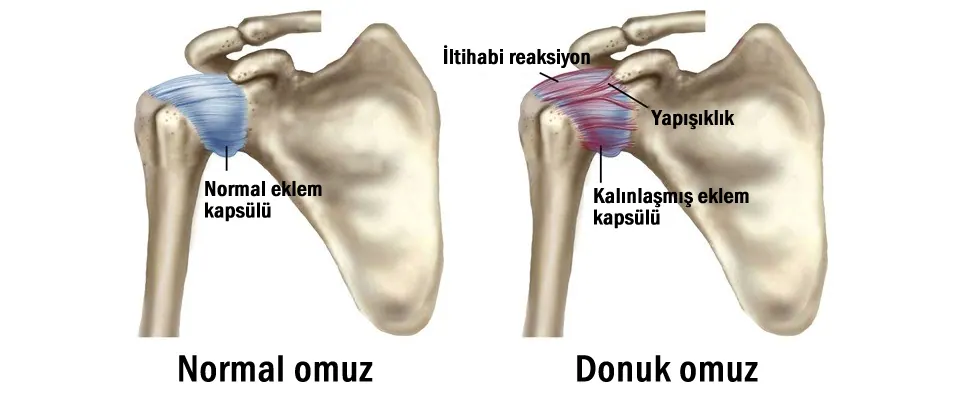
Who is at risk of frozen shoulder?
Frozen shoulder is mostly seen in women aged 40–65. Diabetes is the most important risk factor: 10–20% of people with frozen shoulder have diabetes. Other contributing factors are thyroid disease, stroke, breast or heart surgery and Parkinson's disease; people whose shoulder has been immobile for a long time because of an arm injury or surgery also have a high risk.
What are the symptoms of frozen shoulder?
Usually one shoulder is affected, but in a third of patients both sides may be involved. Restricted movement is an early sign. If you have difficulty reaching above your head, to the opposite shoulder or behind your back, your shoulder movements are restricted. Movement is limited in all directions: the patient cannot comb their hair or reach their back. There is also shoulder and arm pain that becomes more severe, especially at night.
Frozen shoulder develops slowly, in 3 stages over a long period:
● First stage (early, inflammatory "freezing" stage):
Shoulder pain increases while movement becomes restricted in all directions. This stage lasts about 1–3 months.
● Second stage (adhesion, "frozen" stage):
The pain gradually decreases, but the restriction of movement is marked – about 50% less movement compared with the other arm. This stage ends in 4–6 months.
● Third stage ("thawing" stage):
The pain eases considerably and shoulder movements slowly return; the condition starts to improve, although the patient still cannot move the shoulder fully. By the end of the second year most signs have decreased, but about one in five patients still has troublesome pain and restricted movement. After this stage shoulder movement partly recovers. With good treatment the range of motion returns almost to normal. Some patients may need surgery to restore movement.
How is frozen shoulder diagnosed?
The diagnosis is made by examination: shoulder movements are restricted both when the patient moves actively and when the doctor moves the shoulder passively. An MRI may be requested not to diagnose frozen shoulder but to rule out other problems.
How is frozen shoulder treated?
The first-line treatment is non-surgical. Treatment aims to relieve pain and restore movement. For this, anti-inflammatory painkillers, cortisone injections into the joint, careful stretching exercises that do not increase inflammation in the early stages, and ice are used. Once the frozen stage is reached and pain decreases, more demanding exercises can be started. Nerve blocks and radiofrequency treatment of the nerve carrying pain can also give good results.
In patients who do not respond to non-surgical treatment for six months, manipulation under general anaesthesia can be performed. With the muscles fully relaxed, the doctor loosens the capsule with various manoeuvres and opens up shoulder movement. A serious rehabilitation programme afterwards preserves the movement gained.
If movement cannot be regained with manipulation, the thickened soft tissues blocking movement are cut and released with arthroscopic surgery. Rehabilitation is essential after surgery too. Even after surgery, frozen shoulder can recur in 5–10% of cases.
What happens if frozen shoulder is not treated?
Once symptoms start, the duration of the disease varies from patient to patient. Studies show that untreated cases last 3–10 years. Despite this long period, almost full recovery of shoulder movement is possible in many patients. However, some untreated patients are left with restricted movement and permanent after-effects.
The information on this page is for general information only and does not replace an examination and diagnosis.