
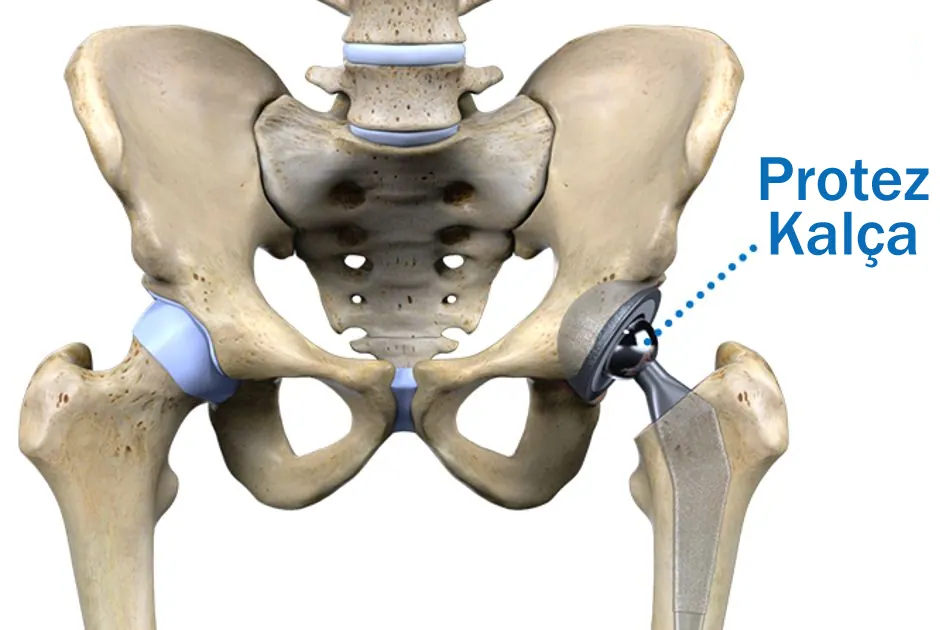
What is joint osteoarthritis? What is joint replacement surgery?
Normally the joint surfaces are covered with slippery, smooth cartilage, so movements are smooth and painless. Wear of the surface cartilage increases friction during movement, and joint movements become restricted and painful. Replacing the damaged surfaces of the joint is called joint replacement (prosthesis) surgery.
When should I have joint replacement surgery?
You can have joint replacement if you have pain, restricted movement, leg deformity or shortening at a level that prevents your daily life, or pain that does not settle at rest.
Is there an age limit for joint replacement?
For osteoarthritis, joint replacement is recommended after the age of 65. The reason is to reduce the number of revision operations needed in the future.
However, age is not a strict criterion for timing the operation; surgery becomes necessary when the patient's quality of life decreases and the pain reaches a disturbing level (not responding to painkillers and limiting your life). Joint replacement can be performed at any age when this situation arises.
In which diseases is a prosthesis used?
- Joint arthrosis (osteoarthritis)
- Rheumatic arthropathies: rheumatoid arthritis, ankylosing spondylitis, SLE, etc.
- Conditions causing avascular necrosis: after hip fractures or dislocations, after use of drugs such as cortisone or methotrexate, etc.
- After failed operations: fracture non-union, problematic prosthesis surgery
- Arthrosis due to past infections
When is a prosthesis not recommended?
- Active infection around the joint
- Infections of neighbouring internal organs
- Progressive osteopenia
- Neuropathic joint
- Muscle diseases, paralysis
- Morbid obesity
- Dementia and inability to care for oneself
What materials are prostheses made of?
Prostheses consist of metal (cobalt-chromium, metal-ceramic (zirconium), titanium), plastic (polyethylene) or ceramic surfaces.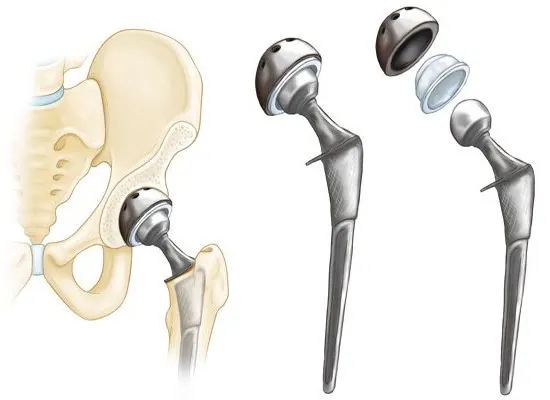
Will the prosthesis be compatible with my body?
Although the material used varies with the person and the procedure, the materials generally do not cause allergic reactions and are resistant to deterioration and breakage. Most patients said to have a prosthesis that "was not accepted by the body" are in fact patients who had a prosthesis infection.
What types of hip prosthesis are there? How is the type chosen?
Hip prostheses can be divided into different types according to how they are fixed to the bone or the materials used on the articulating surfaces. The type is usually decided based on the patient's age, bone quality, lifestyle and the surgeon's experience.
By fixation method:
- Cemented hip prosthesis: The prosthesis is attached to the bone with a medical filling material called bone cement. Today it is preferred in older patients with weak bone structure.
- Cementless hip prosthesis: Most of the hip prostheses we use today are cementless. Their surface is roughened to allow integration with bone. Bone grows into this rough surface, fusing the prosthesis and bone together and fixing the hip prosthesis as if it were part of the body.
By bearing surface:
- Ceramic-on-ceramic: The head and socket are made of ceramic. Because wear is lower, the prosthesis lasts longer. It is preferred in younger patients under 65.
- Metal-on-polyethylene: generally used in patients over 65 and the most commonly used bearing type.
- Metal-on-metal: No longer used today because of reactions to wear particles.
Which type of anaesthesia is suitable?
The method is decided with the anaesthetist during the pre-operative examination. Although the choice depends on the patient, for hip replacement we prefer general anaesthesia because it provides better muscle relaxation.
How long does the operation take?
On average 2 hours. Including one hour of preparation and one hour of recovery, the patient leaves the operating theatre after a total of 3–4 hours.
Through which incisions is hip replacement performed?
Today hip replacement is most commonly performed through three different incisions, or approaches. Each approach has its own advantages and disadvantages, and the surgeon should choose according to the patient.
- Posterior approach (towards the back): preferred because it avoids the risk of cutting the nerve to the hip abductor muscle. Cutting the posterior hip muscles and capsule increases the risk of dislocation.
- Lateral approach (towards the front-side): lower dislocation risk, but the nerve to the abductor muscle is at risk.
- Anterior approach (front): the lowest risk of cutting muscles and nerves, but it requires special equipment and instruments and is not suitable for overweight patients.
How long does a hip prosthesis last?
With proper surgical technique and modern designs, hip prostheses today survive up to 20 years. Keeping weight down, keeping muscles strong and avoiding very strenuous activities can extend this. A loosened prosthesis or parts are replaced surgically; this is called revision surgery.
What are the new developments in hip replacement?
- Developments in prosthesis structure and design: prostheses that are geometrically more stable, bond better to bone and wear less have been developed.
- Advances in surgical technique: operations are now performed through smaller incisions with less tissue damage. Computer-assisted (robotic) techniques reduce the margin of error.
What are the complications of joint replacement?
These operations have been performed successfully by expert hands for many years. Despite the precautions taken, some of the following complications can occur:
- Infection: All surgery carries a risk of infection. After hip replacement the rate is 0.1–1.5%. An infection elsewhere in the body increases the risk of prosthesis infection via the bloodstream. Diseases that weaken the immune system (such as diabetes or HIV), skin problems before surgery and poor hygiene also increase the risk. Eliminating sources of infection, preparing the surgical area well, antibiotics before and after surgery, and infection-prevention measures during the operation reduce the risk.
- Dislocation of the prosthesis (hip dislocation): When the head comes out of the socket it is called a hip dislocation. It occurs in 5–8%. Avoiding unwanted movements for 3 months after surgery and strengthening the muscles with exercise help prevent it.
- Blood clots: Clotting can occur after surgery as circulation slows in the unused leg. Early mobilisation, bandages and compression devices on the legs, aspirin or blood thinners are preventive measures.
- Leg length difference: A pre-existing leg length difference, previous hip surgery, or weak or tight hip muscles may cause the prosthesis to be placed higher or lower, resulting in a leg length difference. Differences of up to 2 cm are tolerated by the body; for larger differences a shoe raise should be used.
- Vessel or nerve damage: can occur from a direct cut or stretching during surgery. Nerve damage from stretching is usually temporary and recovers after some time.
- Bleeding, haematoma
- Fractures around the prosthesis
- Breakage or early wear of the prosthesis, etc.
When will I be on my feet after hip replacement?
Thanks to new prosthesis designs and modern techniques, patients can walk with weight-bearing using a hand support one day after surgery.
How many days will I stay in hospital?
The hospital stay is on average 2–4 days.
When can I drive after hip replacement?
You can drive 6 weeks after surgery, provided the driver's seat is high and you do not lean forward.
Which sports can I do after hip replacement?
Walking can start 6 weeks after surgery. Sports that do not require sudden movements and carry little risk of falling, such as swimming and the exercise bike, can be done.
What should I do to prepare for surgery?
- Tell your doctor about past illnesses, operations and the medicines you use
- Medicines that increase bleeding should be stopped (after consulting your doctor) for the following periods before surgery:
– Coumadin 5 days
– Plavix 7 days
– Trental 7 days
– Aspirin 10 days
– all vitamins and supplements 10 days
– painkillers (NSAIDs) 10 days
– methotrexate 2 weeks
– diet pills 2 weeks.
- After surgery you may need crutches, a walker, a raised toilet seat and grab rails in the bathroom and toilet at home. You will need ice or cold gel packs. Prepare these aids in advance.
- Learn and do the pre-operative exercise programme.
- Stop smoking 2 days before.
- Take a bath the night before and wash the surgical area with an antiseptic solution (4% chlorhexidine gluconate). On the morning of surgery do not use personal care products (lotion, deodorant, perfume), do not wear make-up and remove nail polish.
- Do not eat or drink anything for 8 hours before surgery. Insulin and diabetes tablets are not taken on the morning of surgery; an appropriate drip is given instead. Blood pressure medicines can be taken on the morning of surgery with very little water.
Exercises before joint replacement
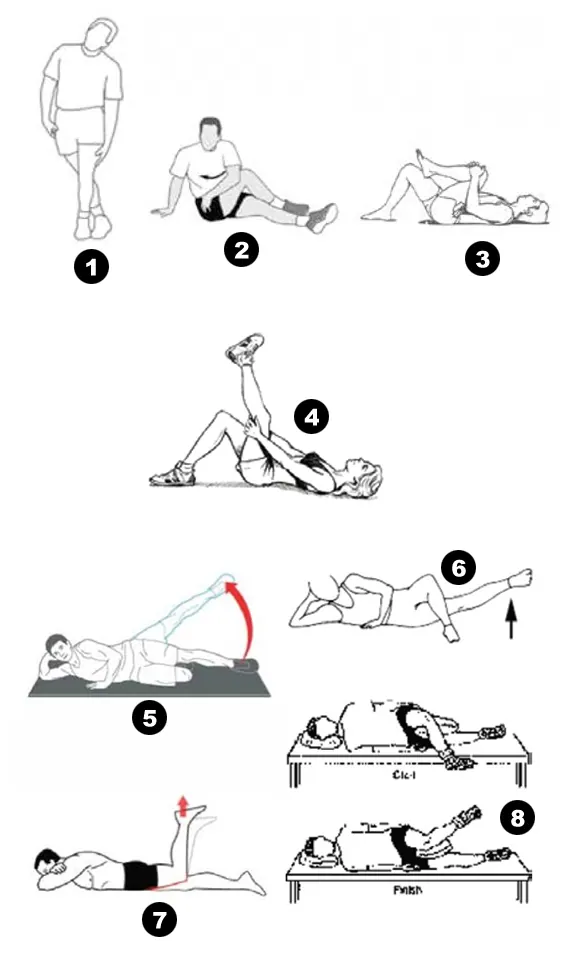
Learning and doing exercises before surgery will help early recovery. Start a few weeks before surgery, 2–3 times a day with 5 repetitions, and increase over time. Always warm up with walking or cycling first.
- Standing iliotibial band stretch: Cross your legs. Slowly lean to the right, hold for 5 seconds, then straighten. Do the same to the left.
- Seated twist and stretch: Sitting, cross one leg over the other. Turn your body towards the bent leg. Press your knee to the opposite side with your elbow and hold for 5 seconds.
- Knee-to-chest exercise: Pull your knee towards your stomach and hold for 5 seconds.
- Hamstring stretch: Hold your thigh from under the knee with both hands or a towel. Straighten your knee fully. Hold for 5 seconds.
- Side leg raise: Lift the leg to the side and hold for 5 seconds.
- Cross-over hip movement: Lift the lower leg off the floor, hold for 5 seconds and lower it.
- Prone hip lift: Bend the knee to 90 degrees, lift the leg from the hip, hold for 5 seconds and lower it.
- Hip rotation: Lie on your side with a pillow between your legs. Let the upper leg hang down while turning the hip outwards. Hold the lower leg for 5 seconds and return. Repeat lying on the other side with the other leg.
The first day after surgery
- If spinal anaesthesia was used, leg movement can take 1–2 hours to return.
- If you have pain or nausea, medication will be given.
- Constipation and difficulty passing urine may occur due to anaesthesia; tell your nurse.
- Patients who shake hands with visitors should wash their hands often and pay attention to hand hygiene.
- Toilets should be high or a raised seat should be used; when sitting down and getting up, take support from wall rails or the toilet edges, not the walker.
- Be careful not to slip on wet floors in the bathroom and after walking. Do not get up without help.
- After the 3rd day, if there is no discharge, you can shower with waterproof dressings.
What problems may occur in the early period after surgery?
– Swelling, bruising: There may be swelling in the operated area, varying from patient to patient. As it decreases, bruising appears, which turns yellow and fades over time.
– Leg swelling: In the first month, sitting for long periods with the leg hanging down increases leg swelling. Raising the leg on a pillow from time to time will reduce it. Ice, cold showers, bandages or anti-embolism stockings reduce swelling. Exercise is also important. If the swelling does not decrease or increases, contact your doctor.
Leg length difference: Especially in the early period after hip replacement, a difference in leg length can be expected. Tight hip muscles tilting the pelvis to one side cause this. It takes 6–8 weeks for the pelvis to rebalance.
– Wound care: Keep the wound dry and clean; do not wet it. If you use a waterproof dressing you can shower after the 3rd day. Be sure to tell your doctor if there is redness, warmth or discharge at the wound!
– Call your doctor in the following situations!
Fever above 38 °C, steadily increasing pain in the operated area, swelling, redness or warmth, difficulty breathing, chest pain or wheezing.
Rehabilitation after joint replacement
Starting exercises early after surgery and doing them regularly restores joint movement, increases muscle strength and helps patients return to their lives sooner. Start each exercise 3–4 times a day with 5 repetitions and increase day by day. If pain, swelling, warmth or tenderness occurs, reduce the number of exercises. If complaints persist, consult your doctor.
You can watch the exercise programmes after hip replacement on our Videos page.
Precautions for patients with a hip prosthesis
After hip replacement, to allow the capsule around the prosthesis to heal and to prevent dislocation, the following movements should be taken care of for 6–12 weeks.
1. When lying down
- Do not lie on the operated hip
- Do not bring your legs together or cross them
- You can lie flat or on your side with a pillow between your legs.
- Lie flat on your back for at least 30 minutes a day
- Do not put a pillow under the operated leg
2. When sitting
– Do not sit on low chairs or armchairs
– Use a raised toilet seat
– Do not lean forward while sitting
– Do not cross your legs
3. Sitting down and getting up from a chair
When sitting, step back until the backs of your knees touch the chair/bed. Let go of the walker, support yourself with your arms on the armrests or bed and sit while sliding the operated leg forward. Do not lean forward while sitting.
When standing up, do the reverse. As you push yourself up from the chair/bed with your arms, stretch the operated leg forward. Never lean forward. Take the walker/stick once you are fully upright.
4. When standing
- Do not bend down to pick something up from the floor
- When bending, do not let your hand go below knee level
- Do not turn your foot excessively inwards or outwards
- When putting on trousers, socks or shoes, do not bend more than 80 degrees; use a long-handled dressing aid.
5. Climbing and going down stairs
Going up stairs, follow the order HEALTHY LEG – OPERATED LEG – CRUTCHES. Going down stairs, follow the order OPERATED LEG – HEALTHY LEG – CRUTCHES.
6. When using a walker
Do not make sudden turns with the walker. Take short steps and turn on your healthy leg. Do not lean on the walker when standing up or sitting down.
7. Using the toilet
An important point to remember is that you cannot use a squat toilet!
Sitting on the toilet: Back up to the toilet until you feel your legs touch it. Hold the toilet support while leaning back with the operated leg in front. Let go of the walker. Supporting yourself with both arms, slowly lower yourself onto the toilet.
Getting up from the toilet: Slide the operated leg forward and hold the toilet support. Stand up using both arms and then hold your walker.
NEVER lean on the walker when sitting on or getting up from the toilet!
8. Dressing
Use aids (dressing stick, reacher) when putting on underwear, trousers or socks. NEVER lean forward.
9. Getting into and out of bed
Sit on the edge of the bed and move yourself back using both hands. When bringing your legs onto the bed, you may ask for help to keep them apart. Do the reverse when getting out of bed.
10. Bathing
At first you can bathe on a level floor sitting on a plastic chair or standing in the shower.
Sexual intercourse after hip replacement
In general, intercourse can be resumed 4–6 weeks after surgery. Initially, positions in which the patient is passive should be preferred; later a more active role can be taken.
Which sports can I do after joint replacement?
Recommended sports: swimming, water aerobics, cycling, golf, dancing, etc. Not recommended: running, sports requiring twisting on a planted foot and sudden movements (football, basketball, etc.), contact sports, heavy work.
What should I do to protect against infection after surgery?
It is very important that your other doctors and your dentist know you have a joint prosthesis. Antibiotic protection is needed to prevent the prosthesis from picking up germs via the bloodstream in all dental procedures (including extractions, root canal treatment and scaling); in all procedures on the digestive system or urinary tract (including endoscopy, colonoscopy and all closed-technique urinary procedures); in upper respiratory tract diseases and procedures; and in all serious infections. For this, 1 hour before the procedure, 2 g of cefalexin or amoxicillin by mouth, or cefazolin by injection – or 600 mg of clindamycin if you are allergic – should be taken.
The information on this page is for general information only and does not replace an examination and diagnosis.