
"Trigger finger syndrome" is a painful condition in which one or more finger joints stay bent and do not straighten when you want them to, and when forced they snap open. When the finger is straightened it suddenly and painfully snaps straight. Because this movement resembles pulling a trigger, the condition is called "trigger finger".
Who gets trigger finger? What causes it?
Trigger finger is generally seen over the age of 45 and more often in women. It is more common in people who use their hands for heavy work or overuse them, and in people with connective tissue disorders such as diabetes and rheumatic diseases.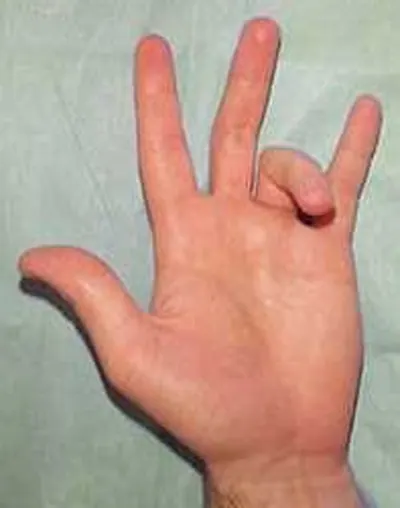
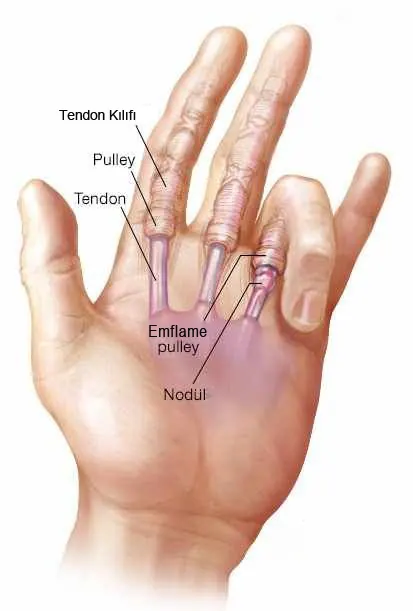
How does the triggering occur?
The bending movement of the finger is provided by the flexor tendons. At the base of the finger, in the palm, there are horizontal bands (bridges) over the tendon called pulleys. When the tendon thickens over time it can no longer move freely under the pulley, and triggering occurs. A painful lump (nodule) can be felt in the palm at the base of the finger over the affected pulley.
How is trigger finger treated?
Because trigger finger results from repeated strenuous movements, avoiding such movements as much as possible is part of non-surgical treatment. Finger exercises can also be effective in mild cases. The aim is to reduce the swelling and free the finger's movement. Anti-inflammatory painkillers can sometimes help, and a steroid injection into the tendon sheath and pulley can relieve the finger. However, injections near the skin carry a risk of skin thinning and permanent colour change, and injections into the tendon carry a risk of tendon rupture.
If these methods do not help, surgery is needed, during which the nerves giving sensation to the finger must be protected. Trigger finger surgery is usually done under local anaesthesia through a 1 cm incision in the palm. The pulley at the base of the finger is opened so that the tendon can move freely again. The patient can use the hand for daily tasks immediately after surgery. Rarely, pain, swelling and tenderness at the site may take a little longer to settle; in such cases hand therapy can help.
The information on this page is for general information only and does not replace an examination and diagnosis.