
A hard bony projection formed by the build-up of calcium salts on the underside of the heel bone is called a "heel spur". It got its name because on X-ray this hard projection looks like a thorn.
A heel spur, which can have many causes, usually results from years of strain on the plantar fascia under the foot and over time makes stepping and walking difficult.
Who gets heel spurs?
Heel spurs are more common in women. Causes include excessive running and jumping sports, faulty foot posture, excess weight and shoes without inner support (flat sandals, flip-flops, high heels, etc.). People with flat feet or high arches, people with diabetes and those with inflammatory or degenerative joint disease are also more prone.
What are the signs of a heel spur?
People with heel spurs often have difficulty putting weight on the inner part of the heel when they wake up in the morning; stepping on it feels like stepping on a thorn. If untreated, the resulting gait disturbance can lead to foot, knee, hip and back problems.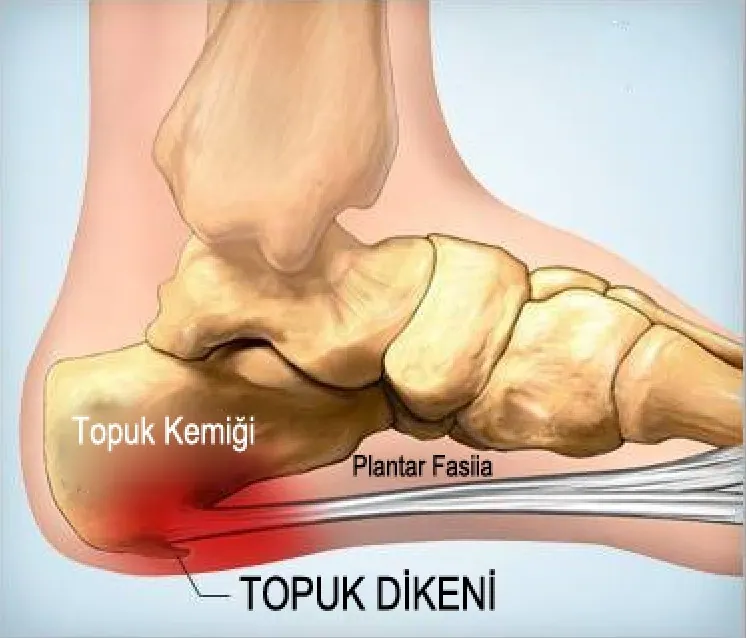
How is a heel spur treated?
Because gait abnormalities are among the main causes, they should be identified before treatment and corrected if present.
The first treatment is rest. Home exercises that stretch the foot muscles can reduce the pain. Non-steroidal anti-inflammatory drugs relieve pain by reducing the inflammatory reaction. Applying ice to the painful area for 20 minutes 3–5 times a day also helps. Patients should not walk barefoot at home, should wear soft-soled slippers and, if possible, prefer trainers to hard-soled shoes. Silicone heel cushions can also be recommended.
Local injections can be given to patients who do not benefit from massage, exercise, medication and cold – cortisone (steroid) or other injections. In recent years, publications on more effective and harmless injections have increased. Rarely, surgery may be needed for patients who do not respond: the tendon is released and the bony projection removed.
"Heel spur" and "plantar fasciitis" should not be confused
The only relationship between these two different conditions is that plantar fasciitis may turn into a heel spur over time. Contrary to popular belief, a heel spur is not a common cause of heel pain; in fact, of 20 patients with a heel spur on X-ray, usually only one has heel pain. The two are often confused and both called "heel spur". To avoid wrong treatment, it is important to distinguish them well and to see a specialist when there is heel pain.
The information on this page is for general information only and does not replace an examination and diagnosis.