
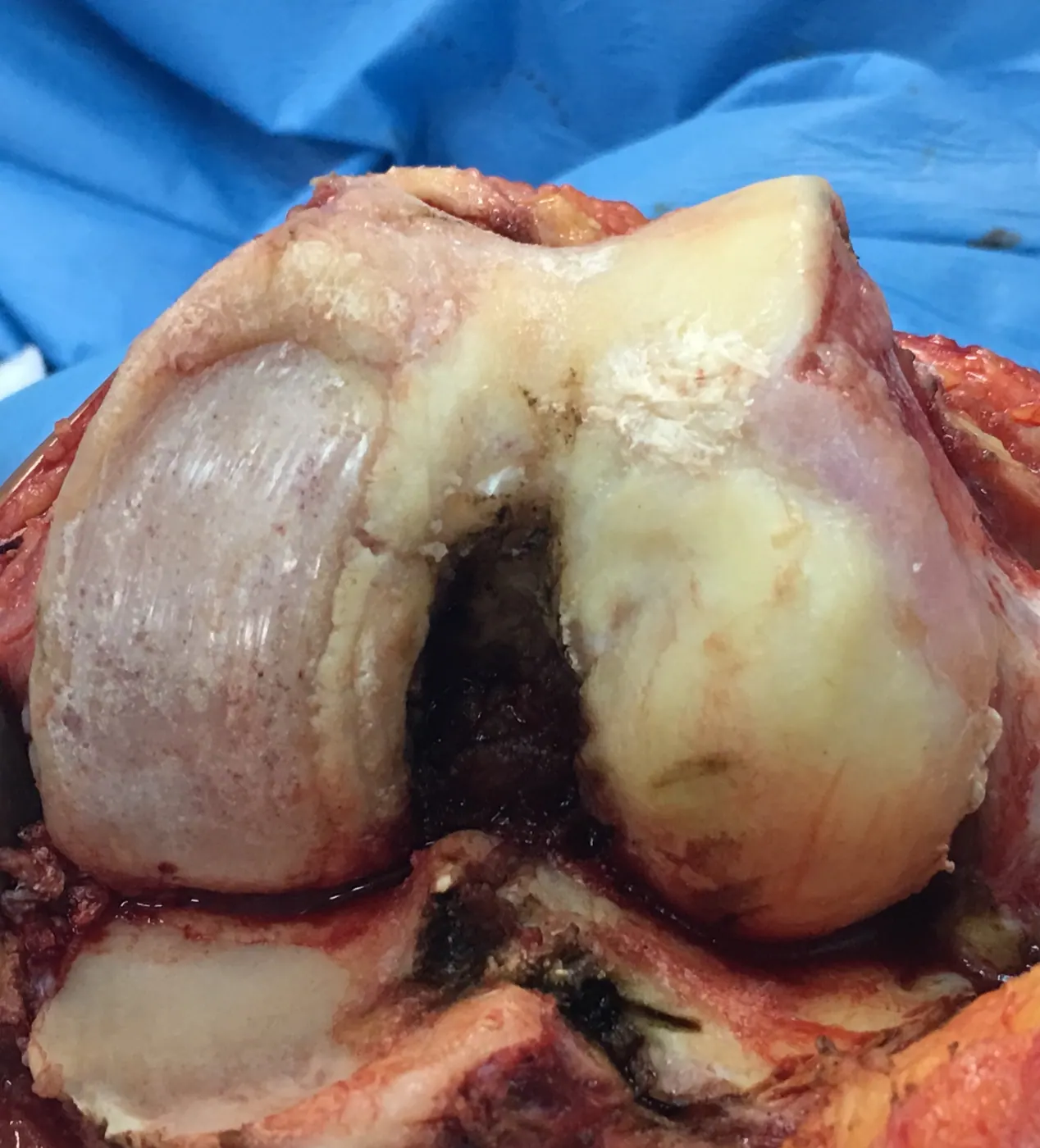
 The medical name of the condition popularly called "calcification" is "osteoarthritis". Although it is called calcification because joint movements become difficult, there is in fact no calcium build-up in the joint. The disease arises from wear of the shiny, smooth cartilage that covers the joint surfaces in healthy joints. Friction between the worn joint surfaces increases and joint movement becomes restricted. Over time, as the wear increases, deformities develop. Osteoarthritis can affect all joints, but it is most often seen in the knee joint.
WHAT CAUSES OSTEOARTHRITIS? WHO IS AT RISK?
The most common cause is ageing. With age, a joint that has been used for many years ages – in other words, its cartilage wears out.
Women are more prone to osteoarthritis than men. Besides cartilage being less resistant in women, osteoarthritis starts earlier in women because of the hormonal effects of menopause. Excess weight, genetic factors, very heavy working conditions and excessively strenuous sports are other causes of early joint wear. Apart from age, joint damage can also result from joint injuries, previous joint surgery, congenital joint diseases, rheumatic diseases, joint infections and various blood disorders.
WHAT ARE THE SYMPTOMS OF OSTEOARTHRITIS?
First, as the damaged joint surfaces rub against each other, crackling or grinding sounds start to come from the joints during movement. At the beginning, joint pain appears after standing or walking for a long time; over time the pain becomes more severe, and more pain comes with less activity. Walking distance becomes increasingly limited. Pain that occurred during the day now disturbs the night. The painful periods during the year last longer, and after a while the pain becomes constant. As a protective mechanism, the joint with increased friction secretes fluid into the joint space to reduce friction, which the patient sees as swelling of the joint. If the swelling becomes large, joint movement is restricted; in this case there is no harm in draining the excess fluid. In advanced osteoarthritis, once the cartilage has worn away the bones also wear, the shape of the joint deteriorates and the legs usually bow inwards, sometimes outwards.
HOW IS IT DIAGNOSED?
In patients showing signs of advanced osteoarthritis, the diagnosis can be made with an X-ray alone. The X-ray shows narrowing of the joint space, bony spurs, and deformity and malalignment of the joint. In the early stages, when cartilage wear is mild, the X-ray is normal and the wear can be shown with MRI.
WHAT ARE THE TREATMENT OPTIONS?
No treatment changes the natural course of osteoarthritis, because the process is in fact the wear of the joint over the years – that is, its ageing. Each treatment option has a stage in which it is useful and a period during which it works. Patients should therefore remain under a doctor's follow-up and be examined at least every 6 months. The appropriate treatment should be chosen for each patient, and the patient should be told to what extent and for how long the treatment will help.
- What can patients do to help their treatment?
- diet and weight loss
- exercise and sports that do not strain the knee: such as walking, swimming and cycling
- avoiding loaded bending of the knee such as squatting and getting up
- applying cold when the knee is swollen and heat when there is dry pain
- using a walking stick during painful periods
- Medication
- painkillers,
- glucosamine and chondroitin sulphate tablets: the aim is to restore the building blocks of cartilage. They cannot bring back cartilage that has completely disappeared; they can only reduce pain and increase activity.
- injection treatments into the joint:
- hyaluronic acid: reduces friction by increasing the joint's lubrication
- Physiotherapy: does not cure the disease but can relieve pain.
- Surgical treatments
- arthroscopic debridement (keyhole surgery): in the early stage, removing cartilage fragments shed into the joint and trapped meniscus fragments can give relief for a few years.
- bone realignment operations: if there is a leg deformity and half of the joint is affected, the shape of the leg is corrected by cutting the bone, and the load distribution in the joint is evened out. Because the damaged part carries less load, this can give the patient relief for 5–10 years.
- joint replacement operations: depending on whether part or all of the joint is damaged, a partial (unicondylar) or total prosthesis can be implanted. Partial prostheses last 8–10 years, total prostheses 15–20 years.
The information on this page is for general information only and does not replace an examination and diagnosis.