
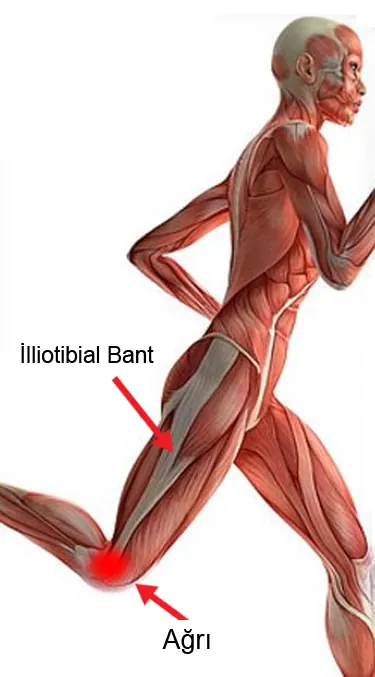
 The iliotibial band (ITB) is a thick, strong band of tissue running from the outer part of the pelvis to the side of the knee. It helps move the hip backwards and outwards and rotate it. During walking or running, the iliotibial band stabilises the knee by preventing excessive movement.
Iliotibial band syndrome, one of the leading causes of pain on the outer side of the knee, can occur when the band rubs over a bony prominence of the knee during bending and straightening. In activities such as incorrect training or long-distance running, repeated bending and straightening of the knee from overuse strains the band. As a result the iliotibial band is injured and stretched, and inflammation and swelling develop. This causes a rubbing sensation on the outer edge of the knee and pain with knee movement. The pain may spread up to the hip.
Who gets ITB syndrome?
It can occur in runners, cyclists and tennis players – in short, in people doing sports that require repeated bending and straightening of the knee. In the general population, sitting for long periods with bent knees, frequently going up and down stairs and wearing high heels can lead to ITB syndrome.
Factors that trigger iliotibial band syndrome:
- a short (tight) iliotibial band
- prominent bony bumps
- a difference in leg length
- lack of running experience
- neglecting warm-up and cool-down
- suddenly and excessively increasing training intensity
- not leaving enough rest between training sessions
- wrong choice of shoes
- training on unsuitable surfaces
- incorrect bicycle set-up
- exercising hard without being fit
- always running in the same direction for long periods
- running downhill
What are the symptoms of ITB syndrome?
The main complaint is pain and burning on the outer side of the knee. The pain occurs when bending and straightening the knee, especially when the knee is slightly bent (30–45 degrees). Sometimes pain is also felt over the bony prominence on the outer side of the hip called the greater trochanter. In the early stages the pain appears only during activity and disappears with rest; in later stages it also occurs at rest. In severe cases swelling may be seen in the painful areas, and crackling, popping or rubbing noises are heard with each knee movement during walking and running.
How is ITB syndrome diagnosed?
ITB syndrome can be diagnosed with a good examination. Injury and swelling of the ITB can also be shown on MRI. X-rays are taken to rule out possible bone problems. Strain or injury of the hamstring muscles at the back of the thigh, damage to the outer (lateral) collateral ligament of the knee, lateral meniscus damage, patellofemoral pain syndrome and trochanteric bursitis can be confused with ITB syndrome and should be kept in mind in the differential diagnosis.
How is ITB syndrome treated?
First, physical activity and sports intensity should be reduced to control the pain. Besides rest, ice and anti-inflammatory painkillers are given. As the pain eases, physiotherapy starts; stretching exercises form the basis of this stage, and massage can also be applied. Over time, strengthening exercises are added.
If there are triggering factors (such as a short ITB, flat feet, poor running technique or a short leg), they need to be identified and corrected.
Most people with ITB syndrome can usually return to exercise within 6 weeks. At first, hill training, slow-pace running and downhill running should be avoided. The most important thing to remember is that treatment must be planned individually.
In cases where exercise, physiotherapy and injections do not help, a tendon release operation is performed.
The information on this page is for general information only and does not replace an examination and diagnosis.