
What is partial (unicondylar) knee replacement?
The knee joint consists of three compartments: the inner half, the outer half and the joint between the kneecap and the knee. When only the inner or outer half of the joint is worn, covering this area with a prosthesis is called partial knee replacement.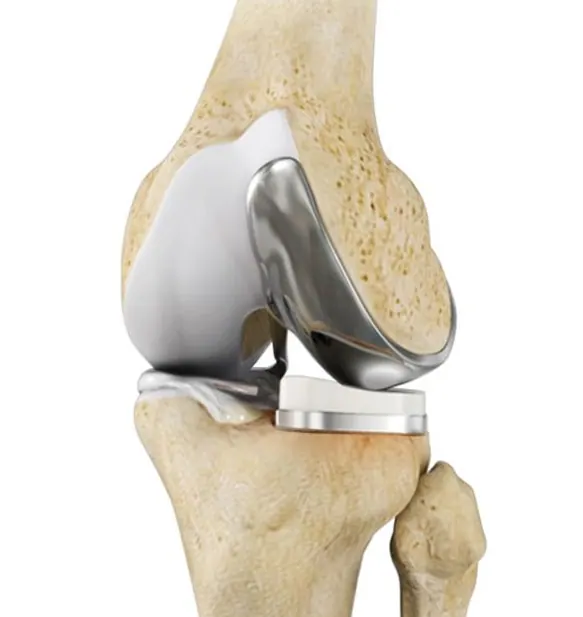
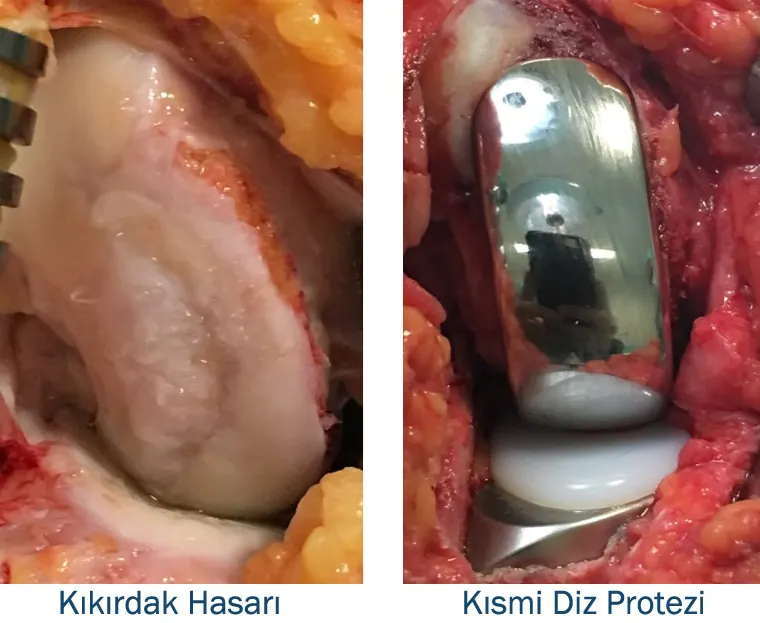
Why does only part of the knee wear out?
In the early stage of knee wear (osteoarthritis) only part of the knee may be worn, and when there is a leg deformity only the inner or outer half of the joint may wear. Because bow legs (O-shaped legs) are more common in our population, we see wear of the inner half of the knee more often. We rarely see patients with knock knees (X-shaped legs), and in that case the outer half wears early.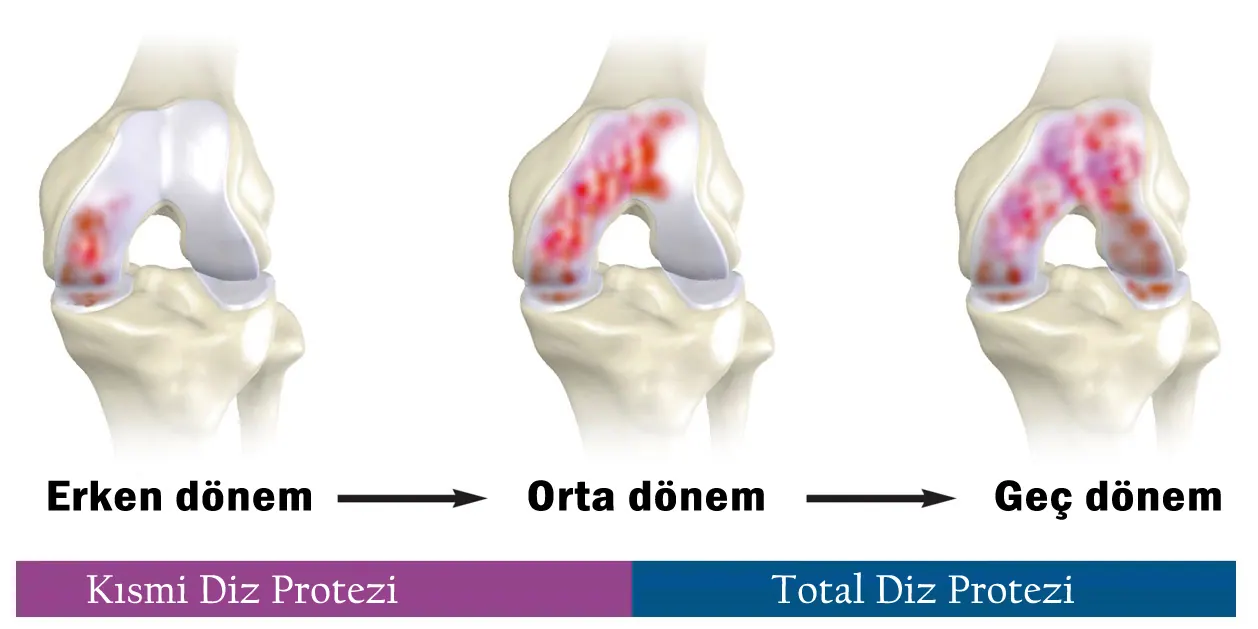
How does partial knee replacement differ from total knee replacement?
Unlike total knee replacement, in partial knee replacement only the worn part of the knee is treated; the other half and the cruciate ligaments in the middle are left untouched.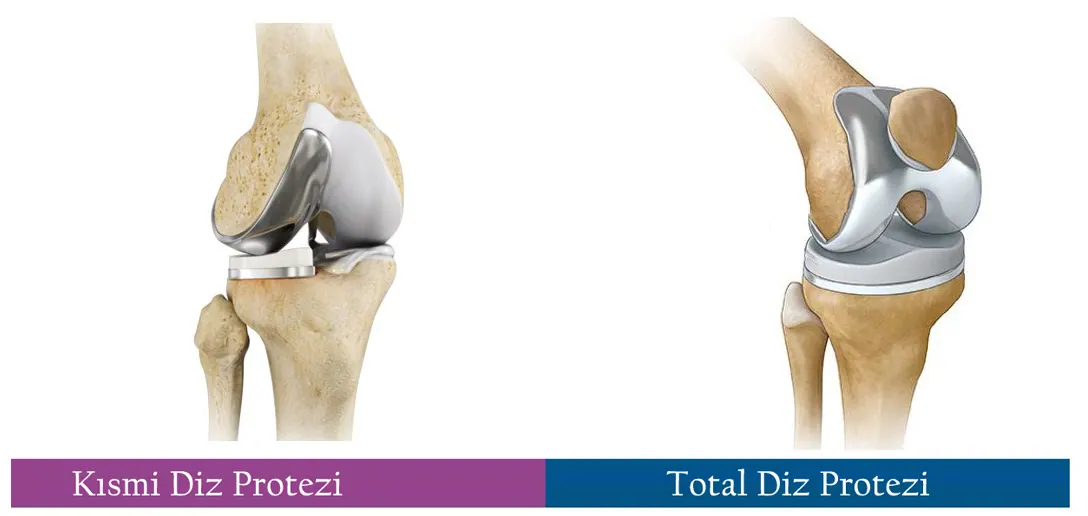
What are the advantages of partial over total knee replacement?
- It is done through a smaller incision
- Less bone is cut
- There is less blood loss
- There is less pain after surgery
- Movement returns earlier, so recovery is shorter.
- Because the cruciate ligaments are not cut, the knee feels more natural.
- Knee bending is usually greater.
Who is partial knee replacement suitable for?
Patients in the early stage of joint wear, i.e. aged 50–60, or older patients in whom only the inner part of the joint is worn, are suitable candidates for partial knee replacement.
In knees with partial wear and a leg deformity, if surgery is delayed too long the remaining healthy part of the knee also wears quickly and the chance of a partial prosthesis is lost. These patients then need total knee replacement.
How long does a partial knee prosthesis last?
Today, thanks to modern designs and good surgical technique, the 10-year survival of partial knee prostheses has reached about 90%. Good surgical technique is very important for long survival, because errors in partial knee replacement are not tolerated by the knee, as the other half is healthy. Robotic systems have been developed today to eliminate this problem.
How is the decision for partial knee replacement made?
Patients who come with complaints of knee osteoarthritis are assessed with examination and X-rays. If necessary, your doctor may request X-rays in different positions or an MRI to make sure the other part of the knee is normal. Still, the final decision is made during surgery: through the incision made for the partial prosthesis, the rest of the knee is inspected and the decision is confirmed. Rarely, the other part of the knee is found to be damaged during surgery, and the incision is extended by 2 cm to switch to a total knee replacement.
When will I be on my feet after partial knee replacement?
Patients can stand up one day after surgery and walk with full weight-bearing. They can take short walks with a hand support.
When will I be discharged from hospital?
On average, patients go home after 3 days.
Can I play sport after partial knee replacement?
Sports that do not require sudden turning and jumping, such as swimming, cycling, golf and bowling, can be done. Competitive and jumping sports are not recommended.
When can I return to work?
Office workers can return to work after 6 weeks. For people doing heavy work there is a risk of early loosening of the prosthesis.
When can I drive?
Driving can be allowed 6 weeks after surgery. What matters is having enough leg strength to press the pedal when a sudden stop is needed.
What are the risks and complications of partial knee replacement?
1. infection: lower than with total knee replacement, below 1%.
2. dislocation: a complication that can develop with mobile-bearing partial knee prostheses. Poor ligament balancing, a deficient anterior cruciate ligament and unwanted movements by the patient can cause it.
3. early wear: can develop depending on how the patient uses the knee or if the surgical technique is not of sufficient quality.
4. knee pain and stiffness: in the early period some stiffness may be felt when starting to walk. If the stiffness persists and the pain gradually increases, conversion from partial to total knee replacement may become necessary.
5. fracture
6. kneecap dislocation
7. blood clots in the legs
8. injuries to vessels, nerves and ligaments
The information on this page is for general information only and does not replace an examination and diagnosis.