
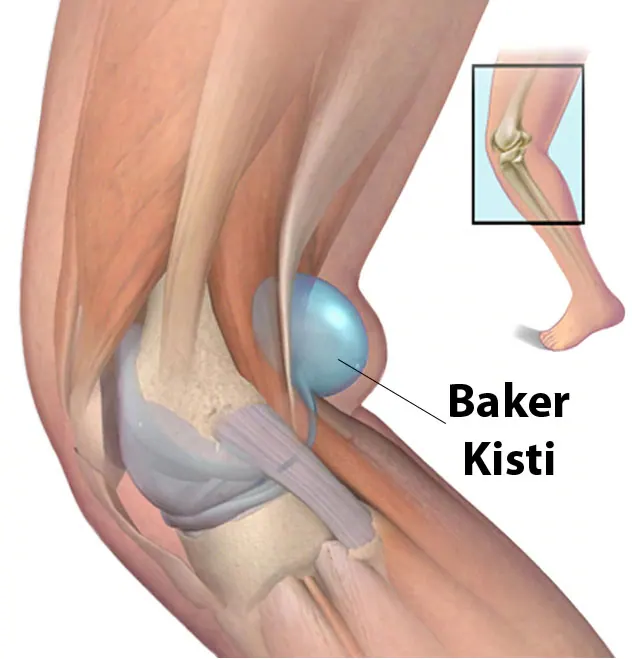
A fluid-filled "Baker's cyst" (popliteal cyst) is a soft swelling at the back of the knee that does not usually cause pain. A Baker's cyst is not actually a true cyst but a bubble connected to the joint space.
What causes a Baker's cyst?
A Baker's cyst usually develops when, because of weakened tissues with age, osteoarthritis or cartilage damage, the joint fluid increases and the rising pressure makes the joint capsule bulge out like a bubble towards the back of the knee. These patients usually also have meniscus wear. In addition, a cyst can develop due to physical activity and sports strain, rheumatic joint inflammation and gout. Rarely, Baker's cysts are also found in children.
What are the symptoms of a Baker's cyst?
The swelling of the cyst is felt in the hollow at the back of the knee. Pain may be accompanied by a feeling of tightness. Sometimes a Baker's cyst causes no complaints; sometimes it causes swelling, stiffness and pain in the knee. These complaints usually increase after physical activity, or after the knee is stretched or forced to bend.
Sometimes the cyst can burst into the calf. The fluid then spreads into the calf, causing severe calf pain, swelling and sometimes redness. Because this can be confused with a blocked vein (thrombosis), you should see a doctor urgently for a correct diagnosis.
How is a Baker's cyst diagnosed?
A Baker's cyst can easily be diagnosed by physical examination; MRI and ultrasound can be used to confirm the diagnosis and detect accompanying problems.
How is a Baker's cyst treated?
A Baker's cyst does not always need treatment. With rest, ice and painkillers the swelling behind the knee decreases and the pain can settle.
In children, a Baker's cyst is monitored and expected to disappear on its own.
Another treatment is drawing off the fluid inside the cyst with a needle, which can be done with ultrasound guidance. However, the cyst may fill up again.
In patients with severe pain or difficulty moving that does not respond to other treatments, the cyst can be removed surgically. However, if the underlying problems (such as osteoarthritis) are not eliminated, the Baker's cyst will recur. For this reason surgery is not the first choice in treating the cyst.
The information on this page is for general information only and does not replace an examination and diagnosis.